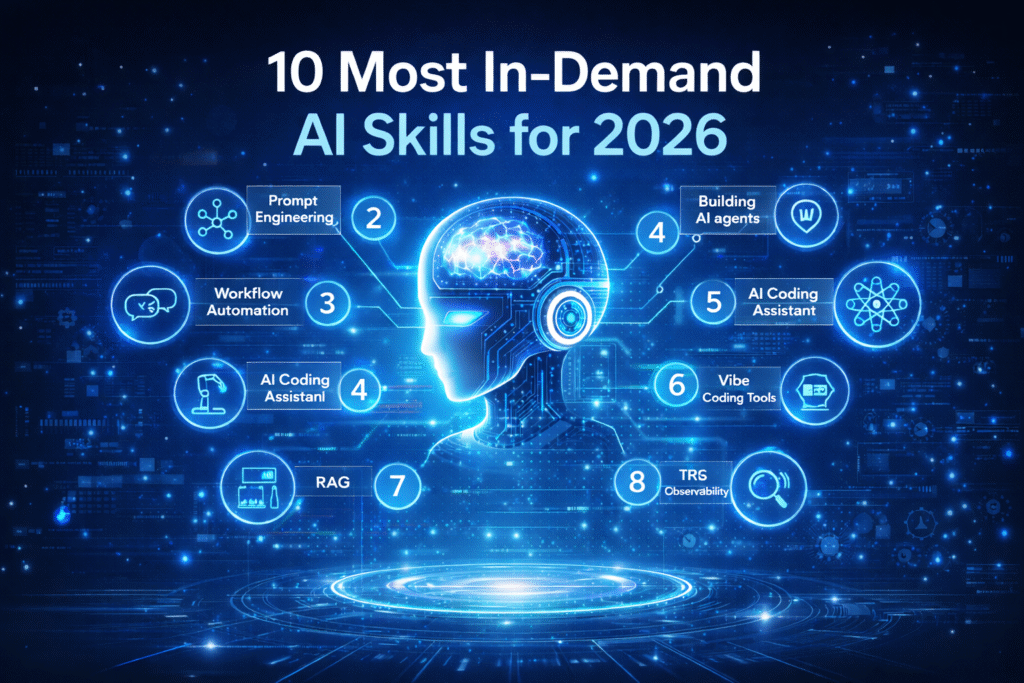
Learning artificial intelligence can feel confusing at first. There are new tools, new terms, and constant updates that make many people wonder where to even begin. At the same time, there is a quiet excitement around the opportunities it brings. The truth is simple. Anyone who takes small and steady steps today can build useful knowledge for tomorrow. This is why understanding the in-demand AI skills matters so much right now.If you are curious about the most in-demand AI Skills for 2026, this guide will help you see what truly deserves your time and effort.
Why Learning AI Skills Matters
Technology is moving fast, but the real shift is happening in how work gets done. Many routine tasks are now supported by smart systems, while creative and strategic work is becoming more valuable. This change is pushing professionals to learn AI skills so they can stay useful in evolving workplaces.
Across industries like marketing, finance, healthcare, and education, companies are quietly prioritizing people who understand AI tools. They help teams save time, make better decisions, and create better experiences for customers. The future is not about replacing humans. It is about working smarter with machines.
Let’s break down the most in-demand AI Skills:
Prompt Engineering
Prompt engineering sounds technical, but at its heart, it is simply the skill of asking better questions. People who can guide AI with clear instructions often get stronger and more accurate results. This makes prompt engineering one of the most in-demand AI Skills in modern digital work.
In real life, this skill shows up everywhere. A marketer writing better campaign ideas, a student summarizing research faster, or a business owner planning strategy with AI support. As language models improve, the ability to communicate clearly with them will remain one of the most in demand skills for the future.
Building AI Agents
AI agents are moving from experiments to everyday tools. These systems can complete tasks, search information, send messages, and even manage workflows with minimal human input. Learning how to build and manage such agents is quickly becoming part of the professionals who want to stay ahead.
Companies are already exploring agents for customer support, research assistance, and internal automation. People who understand how agents think and act will have an important advantage.
Workflow Automation in Daily Work
Many professionals still spend hours on repetitive digital tasks. Workflow automation changes this by connecting tools and letting AI handle routine steps. Understanding automation platforms and logic is very important in business environments.
This does not require deep coding knowledge. Even simple automation can save time in emails, reports, data entry, and scheduling. As organizations search for efficiency, automation will remain one of the most demanding skills in future workplaces where speed and accuracy both matter.
Working Alongside an AI Coding Assistant
AI coding assistants are quietly transforming software development. They help write code, fix errors, and explain complex logic in simple language. Because of this, knowing how to collaborate with such assistants is becoming one of the most in-demand AI skills in the technology world.
Even non-programmers benefit from basic coding awareness supported by AI. Small businesses can build tools faster, students can learn programming concepts quickly, and startups can test ideas without large teams. This shift shows why coding literacy supported by AI is part of the most in-demand skills for the future.
Understanding Vibe Coding Tools
Vibe coding is gaining attention in the industry. Instead of writing every line manually, creators describe what they want, and AI generates working software or design elements.
This approach lowers the barrier to building digital products. Someone with creativity and patience can now create apps, websites, or prototypes without deep technical training. Over time, this could redefine who gets to participate in technology creation across the world.
Retrieval Augmented Generation and Smarter Knowledge
Retrieval augmented generation, often called RAG, helps AI provide answers based on real and trusted data sources. This makes responses more accurate and useful in professional settings. Because businesses depend on reliable information, RAG knowledge is becoming important in data-driven industries.
From legal research to medical references and company knowledge bases, RAG allows AI to work with real context instead of guessing.
Answer Engine Optimization
Search behavior is changing. People now ask questions directly to AI assistants instead of typing short keywords into search engines. Answer engine optimization, or AEO, focuses on making content easy for AI to understand and present.
Writers, marketers, and educators must now think about clarity, structure, and trust. Content that answers real questions simply is more likely to appear in AI generated responses.
AI Tools Stacking for Real Productivity
Using a single AI tool is helpful, but combining several tools creates stronger results. This practice, known as AI tools stacking, allows professionals to connect writing tools, automation systems, research assistants, and analytics platforms. Learning this coordination is most demanding skills in modern workflows.
People who master stacking often work faster without sacrificing quality. They build smooth systems where each tool supports the next step. As digital ecosystems expand, this ability will continue to rank among the top skills in the next 10 years of professional life.
AI Content Generation with Human Judgment
AI can now create text, images, audio, and video within seconds. Still, human judgment remains essential for meaning, emotion, and accuracy. Knowing how to guide AI content responsibly is important for creators, marketers, and educators.
The real value lies in blending speed with authenticity. Readers connect with ideas that feel thoughtful and honest. Professionals who combine AI efficiency with human storytelling will stay relevant as content creation evolves across global audiences.
LLM Observability
As organizations depend more on large language models, they must also monitor performance, accuracy, and safety. LLM observability focuses on tracking how AI systems behave in real environments.
Trust will define the future of AI adoption. Companies need people who can detect errors, reduce bias, and ensure ethical use. This growing need connects directly with the most demanding skills in future digital systems, where reliability matters as much as innovation.
Salary Trends for most in-demand AI Skills in India
| AI Skill | Entry Level (0-2 yrs) | Mid-Level (3-6 yrs) | Senior (7+ yrs) |
| Building AI Agents | ₹12 – ₹18 LPA | ₹25 – ₹45 LPA | ₹55 – ₹90 LPA |
| LLM Observability | ₹10 – ₹15 LPA | ₹22 – ₹40 LPA | ₹50 – ₹85 LPA |
| RAG (Retrieval) | ₹9 – ₹14 LPA | ₹20 – ₹38 LPA | ₹45 – ₹75 LPA |
| AI Coding Assistant | ₹8 – ₹12 LPA | ₹18 – ₹32 LPA | ₹40 – ₹65 LPA |
| Workflow Automation | ₹7 – ₹11 LPA | ₹16 – ₹28 LPA | ₹35 – ₹60 LPA |
| Prompt Engineering | ₹6 – ₹10 LPA | ₹14 – ₹24 LPA | ₹30 – ₹50 LPA |
| Vibe Coding Tools | ₹6 – ₹9 LPA | ₹12 – ₹22 LPA | ₹28 – ₹45 LPA |
| AEO (Answer Engine Opt.) | ₹5 – ₹8 LPA | ₹11 – ₹19 LPA | ₹25 – ₹40 LPA |
| AI Tools Stacking | ₹5 – ₹8 LPA | ₹10 – ₹18 LPA | ₹22 – ₹35 LPA |
| AI Content Generation | ₹4 – ₹7 LPA | ₹9 – ₹15 LPA | ₹20 – ₹30 LPA |
Note: Salaries vary heavily by city, company type, and skill level. The table shows India market ranges based on commonly reported industry benchmarks like AmbitionBox-linked estimates and market guides.
Conclusion
Learning AI does not require perfection. It simply requires curiosity and consistent effort. The world is moving toward smarter tools, but humans who understand these AI skills will guide how these tools are used. Whether you are a student, professional, or business owner, small learning steps today can open meaningful opportunities tomorrow.
Instead of feeling overwhelmed, focus on one skill at a time. Explore, practice, and stay patient with the process. Over the coming years, these skills will continue shaping careers, creativity, and everyday work across the globe. Those who begin learning now will quietly build confidence for a future that rewards adaptability, clarity, and thoughtful use of technology.
FAQs
1. What are the most in-demand AI Skills for 2026?
They include prompt engineering, AI agents, workflow automation, RAG, AEO, AI content creation, and LLM monitoring used across many industries.
2. Do I need coding knowledge to learn AI skills?
No, many AI skills like prompting and automation can be learned without deep coding knowledge.
3. Which AI skill is best for beginners?
Prompt engineering and basic AI tool usage are the easiest and most practical starting points.
4. How long does it take to learn useful AI skills?
Basic AI skills can be learned in weeks, while advanced expertise may take several months of consistent practice.
5. Will AI replace jobs or create new ones?
AI will change existing jobs but will also create many new roles for people with relevant AI skills.
Related Blogs: