What is AI in Finance?
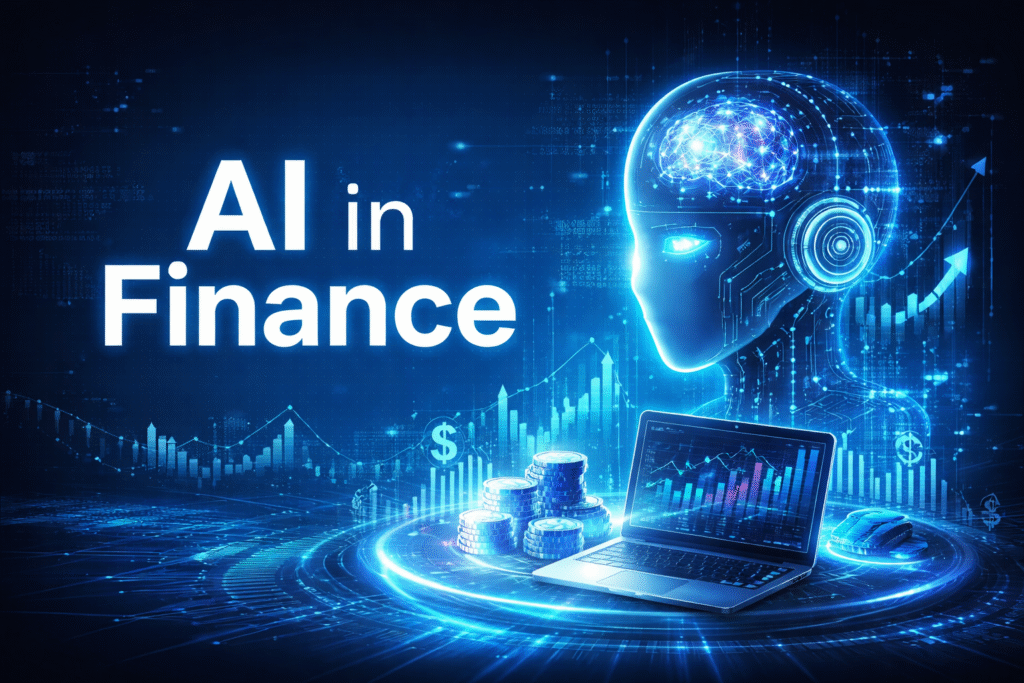
AI in finance refers to the use of Artificial Intelligence technologies, like machine learning (ML), natural language processing (NLP), and predictive analytics, to improve how financial institutions make decisions and deliver services. It helps banks, fintech companies, insurance firms, and investment platforms automate complex tasks, detect risks early, reduce fraud, and personalize customer interactions.
AI turns messy financial data into real-time intelligence, and it supports better decisions at scale. That’s why AI is now becoming a core part of modern financial systems. The World Economic Forum also highlights AI as a key driver of transformation across industries, including financial services.
Why is AI in Finance important?
AI matters in finance because money moves fast, and mistakes move faster. In finance, a small error can create huge losses, reputational damage, or compliance issues. AI helps institutions operate smarter, faster, and more securely.
Let’s break it down point-by-point.
Operational efficiency
Finance involves repetitive workflows, reconciliations, document checks, transaction validations, reporting, customer queries, and compliance checks. Humans can do it, but it costs time and also invites manual errors. AI improves operational efficiency by automating these tasks and speeding up processing.
For example, AI systems can extract data from documents, verify transactions, and detect anomalies across millions of records. That reduces workload, improves accuracy, and frees teams to focus on higher-value work like financial planning and strategy.
Risk management
Finance runs on risk. Credit risk, market risk, liquidity risk, operational risk, it’s basically a buffet of danger.
AI improves risk management by identifying patterns in customer behavior, market movements, and transaction history. It helps financial institutions detect early warning signs that traditional methods might miss. Machine learning models can also update predictions as new data arrives, which improves speed and accuracy in changing market conditions.
Customer experience
Customers now expect banking to be fast, digital, and personalized. People don’t want to wait on hold for 20 minutes just to hear please visit the branch. AI helps deliver better customer experience through personalized recommendations, faster support, and intelligent financial guidance.
Chatbots can answer routine questions instantly. AI can also recommend better savings plans, detect unusual spending patterns, and support smarter budgeting experiences. This improves satisfaction and reduces service costs.
Regulatory compliance
Financial institutions must follow strict regulations related to AML (anti-money laundering), KYC (know your customer), data privacy, and fraud prevention. Compliance teams often have to review huge datasets and alerts, which creates heavy workload and delays.
AI supports compliance by monitoring transactions in real time, identifying suspicious patterns, and generating alerts. It also helps prioritize risk-level alerts so teams don’t waste time on low-risk cases. This becomes crucial as transaction volumes grow year after year.
Competitive advantage
AI has become a competitive edge in finance. Institutions that use AI can approve loans faster, detect fraud earlier, reduce customer churn, and launch personalized services quickly. Those who don’t use AI will struggle, not because they are bad, but because they operate slower.
How do financial institutions use AI?
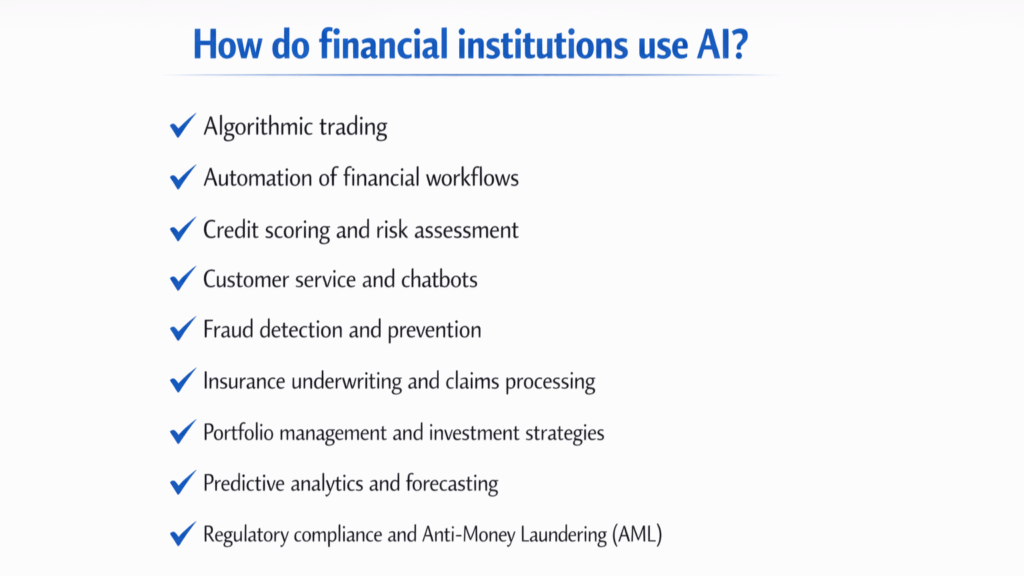
Now let’s go to reality. Here are the key ways financial institutions use AI today.
Algorithmic trading
AI-driven algorithmic trading uses machine learning models to analyze market trends, price movements, and signals. These systems can execute trades faster than humans and react to market conditions in milliseconds. That speed matters in high-frequency trading environments.
But AI trading comes with risks too. Models can fail when markets behave unexpectedly. That’s why firms should combine AI with strict risk management and human oversight.
Automation of financial workflows
Banks and finance teams handle large volumes of data and documents. AI automates repetitive tasks like data entry, invoice validation, document classification, and reconciliation workflows. This reduces processing time and human effort.
Credit scoring and risk assessment
Traditional credit scoring often relies on limited factors. AI models can assess a wider range of signals like transaction behavior, repayment consistency, spending patterns, and financial habits. This improves credit scoring accuracy and allows institutions to make smarter lending decisions.
This is especially useful in underserved markets where customers may not have long credit histories.
Customer service and chatbots
AI chatbots and virtual assistants improve customer service by handling common queries like balance checks, account updates, card blocking, and loan details. AI can also help agents by summarizing customer history and suggesting responses.
This reduces workload on human agents and improves support speed. Many banks now use conversational AI as a first support layer.
Fraud detection and prevention
Fraud detection is one of the strongest use cases for AI in finance. AI systems can detect suspicious transaction patterns, unusual login behaviors, new device risk, and abnormal spending activity. They can flag fraud early, even before customers notice.
AI works well here because fraud patterns evolve. Rule-based systems struggle because fraudsters adapt quickly. ML models can adjust faster.
Insurance underwriting and claims processing
Insurance companies use AI to assess risk profiles, detect fraud, automate claims verification, and speed up approvals. AI can analyze customer data and documentation faster than manual processes.
This improves claim processing speed and reduces false claims. It also improves customer satisfaction because no one likes waiting weeks for claim updates.
Portfolio management and investment strategies
AI supports portfolio management by analyzing market data, risk signals, and performance metrics. Robo-advisors use AI algorithms to suggest portfolio allocations based on risk profile and goals.
AI also helps track diversification, expected returns, and portfolio rebalancing. But human strategy still matters, especially during volatile markets.
Predictive analytics and forecasting
Banks and finance firms use predictive analytics to forecast demand, cash flow trends, market movement, customer churn, default risk, and spending trends. Forecasting supports better planning and reduces surprises.
AI forecasting becomes more useful when institutions combine it with real-time data feeds.
Regulatory compliance and anti-money laundering (AML)
AI helps with AML by monitoring suspicious transactions, detecting laundering patterns, and generating automated risk flags. It also reduces false positives by prioritizing alerts based on probability.
Benefits of AI in Finance
Improved risk management
AI detects risks earlier than manual reviews. It flags fraud, predicts defaults, and identifies unstable customer behavior patterns. It also supports smarter monitoring of market and liquidity risks. Better risk management reduces losses and builds long-term trust.
Enhanced efficiency
AI improves efficiency by automating repetitive work and reducing processing time. Financial institutions can deliver services faster with fewer errors.
This also saves money. Not by firing teams, but by making teams focus on complex work instead of repetitive tasks.
Personalized experiences
AI helps finance brands personalize customer journeys. It can recommend financial products, savings plans, loan offers, and credit upgrades based on customer behavior.
Scalability
Finance firms grow quickly. Customer demand increases, transaction volumes explode, and support requests rise. AI enables scalability by handling large volumes without linear increase in manpower. It becomes the difference between growing smoothly and collapsing under workload.
Expanded financial inclusion
AI can support financial inclusion by improving credit scoring for people with limited credit histories. It can help institutions offer microloans and personalized products to underserved segments.
Challenges of AI in Finance
AI is powerful, but it isn’t flawless. These challenges matter a lot in financial systems.
Bias in algorithms
AI models learn from data, and finance data often reflects social inequality. If institutions train models on biased data, the system can unfairly reject loans or limit access for certain groups. This becomes both a legal and ethical issue. Institutions must audit models and train responsibly.
Lack of explainability
Many AI models act like black boxes. They produce results without clear reasoning. In finance, that creates problems because regulators and customers need explanations.
Cybersecurity risks
AI systems also expand attack surfaces. Hackers can attempt model manipulation, prompt injection, fraud automation, and data extraction. AI can help detect cyber threats, but it can also enable attackers. Financial institutions must combine AI with strong cybersecurity frameworks.
Data privacy concerns
Finance data is highly sensitive. AI requires large datasets, but privacy regulations require strict controls. Institutions must ensure safe data handling, proper access, and secure storage.
Regulatory uncertainty
AI grows fast, but regulations move slowly. Institutions often face uncertainty about how AI decisions should comply with existing laws, and what future compliance rules will look like. This makes governance, documentation, and model monitoring critical.
Future Trends for AI in Finance
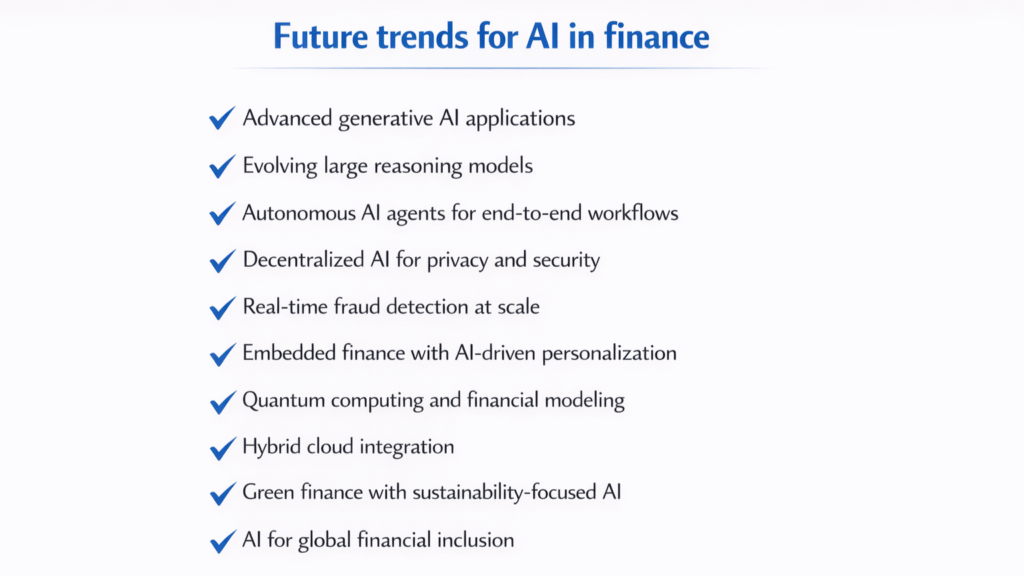
This section matters most for search engines and readers because it targets future intent keywords.
Advanced generative AI applications
Generative AI will expand in finance for drafting reports, summarizing financial statements, preparing client updates, and generating internal documentation. It will also help with research analysis and investment memo drafting.
Evolving large reasoning models
Finance requires logical reasoning, not just language generation. Future AI models will improve multi-step reasoning for scenarios like credit risk analysis, portfolio decisions, and compliance checks. This will make AI more reliable for decision support roles.
Autonomous AI agents for end-to-end workflows
AI agents will handle entire workflows like loan processing, compliance checks, fraud alert triage, and customer onboarding. They will act like digital employees, coordinating tasks across tools.
Decentralized AI for privacy and security
Privacy-focused AI will grow, especially for sensitive financial data. Decentralized AI approaches and federated learning will help institutions train models without exposing raw data. This will support compliance and reduce risk.
Real-time fraud detection at scale
Fraud will become faster and smarter. AI-based fraud detection will move toward real-time prevention at massive scale. Models will monitor behavioral patterns continuously instead of reacting after fraud happens.
Embedded finance with AI-driven personalization
Embedded finance means financial services integrated into apps and platforms. AI will personalize these services in real time, offering smarter lending, insurance, payments, and savings tools directly inside digital ecosystems.
Quantum computing and financial modeling
Quantum computing is still early, but finance will experiment with it for complex modeling, risk simulations, and optimization tasks. This trend will take time, but the research interest will grow.
Hybrid cloud integration
Finance firms will use hybrid cloud environments to balance compliance and scalability. AI workloads will run across private and public clouds with governance controls.
Green finance with sustainability-focused AI
AI will also support ESG analytics, sustainability scoring, climate risk prediction, and green investment monitoring. Institutions will use AI to meet sustainability reporting needs.
AI for global financial inclusion
AI will expand inclusion through microfinance support, better credit assessment, and affordable personalization. This trend can grow strongly in emerging markets.
Key Takeaways
- AI in finance automates workflows and improves risk management.
- Financial institutions use AI for fraud detection, credit scoring, AML, forecasting, and customer service.
- AI improves efficiency, personalization, scalability, and inclusion.
- Challenges include bias, explainability issues, cybersecurity risk, and regulatory uncertainty.
- The future includes AI agents, generative finance tools, privacy-focused AI, and real-time fraud prevention.
Final Thoughts
Finance always evolves toward accuracy and trust. AI supports them when institutions implement it responsibly. The winners won’t be firms that use the most AI. The winners will be firms that use AI with governance, transparency, and strong security.
FAQs
1. What is AI in finance?
AI in finance refers to using machine learning and automation to improve workflows like lending decisions, fraud detection, forecasting, customer service, and compliance.
2. How is AI used in banking?
Banks use AI for chatbots, loan risk assessment, fraud detection, AML monitoring, predictive analytics, and workflow automation.
3. Can AI detect fraud in real time?
Yes. AI can detect fraud patterns quickly and flag suspicious activity. Modern fraud systems use real-time transaction monitoring to reduce loss.
4. What are the biggest risks of AI in finance?
Bias, lack of explainability, cybersecurity threats, privacy issues, and regulatory uncertainty are the main risks.
5. What is the future of AI in finance?
The future includes generative AI for reporting, autonomous AI agents for workflows, privacy-focused decentralized AI, and real-time fraud detection at scale.
Suggested Blogs: