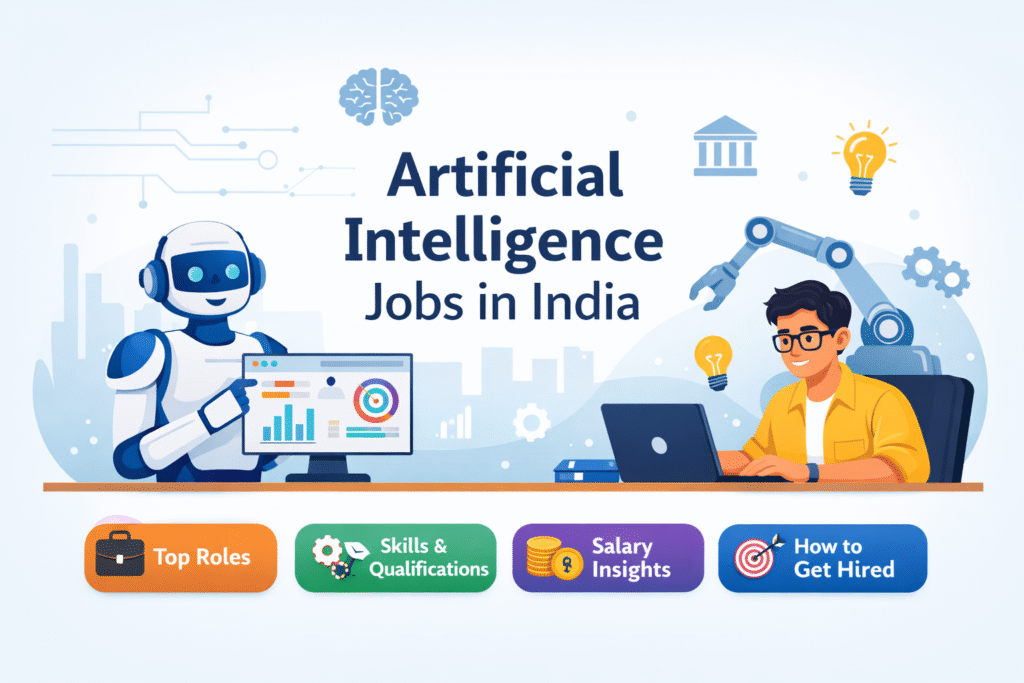
Artificial Intelligence is no longer a future technology. It’s already sitting in your office, writing emails, detecting fraud, recommending products, and occasionally suggesting very questionable autocorrect words.
AI is growing fast, and so is the demand for professionals who can build, deploy, and manage AI systems. From startups in Bengaluru to enterprise teams in Hyderabad and Gurgaon, companies now treat AI as a business priority, not an innovation side-project.
If you’re exploring career options and you want a field with high demand, strong pay, and long-term relevance, AI deserves your attention.
What is Artificial Intelligence (AI)?
Artificial Intelligence refers to computer systems that can perform tasks that normally require human intelligence. These tasks include:
- Understanding language (like chatbots)
- Recognizing images and speech
- Making predictions based on data
- Automating decisions and processes
Most AI jobs in India today revolve around Machine Learning, where systems learn patterns from data instead of following fixed rules.
Significance of Artificial Intelligence
AI matters because it solves real business problems at scale. Here’s why industries invest heavily in it.
1. Automating Tasks Efficiently
AI automates repetitive work like sorting tickets, reviewing documents, and detecting spam. Companies save time, reduce errors, and move faster.
2. Better Decision-Making
AI helps businesses make smarter decisions using data. It detects patterns humans can miss, especially when the dataset is very big.
3. Personalized Services
Ever noticed how Netflix recommends shows that you may like? That’s AI-driven personalization, now used across shopping, banking, healthcare, and education.
4. Impact on Industries
AI changes how industries operate. In finance, it fights fraud, in healthcare, it supports diagnostics, and in manufacturing, it predicts breakdowns.
5. Improving Customer Experience
Chatbots, recommendation engines, and smart customer support workflows run on AI. It processes data quickly, which makes services quicker and easier, particularly on online platforms.
Why You Should Choose Artificial Intelligence as a Career?
1. High Demand for AI Skills
AI and machine learning roles rank among the fastest-growing jobs globally, as highlighted by the World Economic Forum. India also shows fast growth in AI hiring trends across industries, as NASSCOM notes.
2. Diverse Job Opportunities
AI careers are not limited to coding models. You can work in product, consulting, research, robotics, data engineering, and more.
3. Innovation and Impact
You don’t just do a task. You build systems that can impact thousands or even millions of users.
4. Learning and Growth Potential
AI evolves quickly. That’s stressful, but also exciting. If you enjoy learning, you will never get bored.
5. Positive Societal Contributions
AI improves public services, healthcare access, smart agriculture, disaster response, and language technology. India’s government-led initiatives also support AI skilling and workforce development through IndiaAI Mission.
Top Artificial Intelligence Jobs in India
Let’s break down the most in-demand AI roles:
1. Data Scientist
Data Scientists use statistics, coding, and ML to solve business problems. They work with messy datasets, create models, and deliver insights. They work in E-commerce, fintech, SaaS startups, consulting firms, IT services, and healthcare in analytics teams.
2. Machine Learning Engineer
ML Engineers focus on building and deploying machine learning models into production systems. They care about performance, speed, scalability, and pipelines.
3. AI Research Scientist
They push the boundaries of AI. They experiment, publish, test new architectures, and improve model capabilities. In India, this role appears in big-tech labs, some startups, and top research institutes.
4. AI Product Manager
They define what AI product to build, why it matters, and how it should work. They connect business goals with data and engineering execution. This is a strong career path for people who want AI impact without living inside Jupyter notebooks forever.
5. AI Consultant
They help companies adopt AI, select use cases, build roadmaps, improve processes, and estimate ROI. If you enjoy strategy and tech, this role will fit you.
6. Robotics Engineer
They build robots and intelligent automation systems using AI, sensors, control systems, and computer vision. This role is strong in manufacturing automation, logistics, defense tech, and industrial robotics.
Skills and Qualifications Required for AI Jobs in India
1. Technical Skills
Programming Languages
If you want an AI job in India, you must treat programming like your basic survival skill, not an optional add-on. Most companies expect you to write clean, working code, not just copy-paste from tutorials. Python stays the top requirement because it powers AI libraries like TensorFlow, PyTorch, and scikit-learn.
Alongside Python, you should learn SQL, because most AI work starts with data stored in databases. If you skip SQL, you will struggle in real job roles. Some companies also use Java, C++, or JavaScript for production systems, so learning the basics of at least one extra language gives you an edge in interviews and real projects.
Machine Learning & Deep Learning
Machine Learning is where the real career value sits. Companies don’t just want people who know AI. They want professionals who can build models, evaluate them, and improve them. You must understand supervised learning (classification, regression), unsupervised learning (clustering), and model evaluation metrics like precision, recall, and F1-score.
Deep learning matters even more now because India’s AI growth includes NLP tools, recommendation systems, and computer vision projects. If you understand neural networks, embeddings, transformers, and model tuning, you won’t just qualify for the job, but you will stand out.
Data Science & Big Data
In the real world, AI is not mostly about modeling. It’s about cleaning, shaping, and understanding messy data. Companies hire AI professionals who can handle missing values, outliers, biased datasets, and inconsistent formats. You must know how to use libraries like Pandas and NumPy, and also learn handling large datasets with tools like Apache Spark.
Companies deal with huge volumes of customer behavior and transaction data, so big data skills improve your chances of getting hired quickly, especially in finance, e-commerce, and IT services.
2. Mathematical and Statistical Knowledge
Linear Algebra and Calculus
Many people ignore maths because it feels difficult, but maths separates AI users from AI builders. Linear algebra explains how models process data in vectors and matrices. Calculus supports how algorithms optimize learning through gradient descent.
You do not need to solve advanced textbook proofs, but you must understand concepts like vectors, matrix multiplication, derivatives, and optimization basics. If you know the logic behind learning, debugging models becomes easier, and you stop blindly tweaking parameters.
Statistics
Statistics is the backbone of decision-making in AI jobs. Companies use AI to reduce uncertainty and improve predictions, and statistics trains you to handle uncertainty properly. You must understand probability, distributions, correlation vs causation, hypothesis testing, variance, sampling, and confidence intervals.
This knowledge helps you avoid common real-world mistakes, like trusting high accuracy results from biased data. In interviews, strong statistics knowledge shows maturity, and recruiters treat that as a serious advantage.
3. Soft Skills
Problem-Solving Abilities
You won’t get paid for knowing libraries, you get paid for solving business problems using those libraries. Companies specifically look for candidates who can think step-by-step, ask the right questions, define the problem clearly, and choose the correct approach.
Communication Skills
Communication decides your growth speed in an AI career. You will often explain technical work to non-technical stakeholders like founders, managers, marketers, or clients. If you cannot simplify your results and explain why your model works, your impact stays limited.
Teamwork
AI is not a solo profession. You will collaborate with data engineers, backend developers, product managers, and domain experts. You might build the model, but another team will deploy it, and another team will monitor results. If you cannot work well with others, your work won’t scale, and companies won’t trust you with high-impact projects.
4. Qualifications
Educational Background
Degree helps, but it doesn’t guarantee a job. Many companies shortlist candidates from engineering and computer science backgrounds. But the field is open to students from maths, stats, economics, and even non-technical backgrounds if they develop the right skills. Your degree gives structure, but your projects prove ability. That’s why companies value portfolios, and GitHub work more than marksheets in many AI hiring processes.
Certifications
Certifications help only when they prove structured learning. Recruiters don’t respect random certificates, but they do respect certifications that show industry-standard competency. Courses from platforms like Coursera, DeepLearning.AI, Google, IBM, and Microsoft provide credibility if you pair them with projects.
Experience
Even if you are a fresher, you can build experience through internships, freelance work, open-source contributions, or real-world case studies. Recruiters want to see that you have worked with actual data and solved problems.
5. Industry-Specific Knowledge
Domain Knowledge
This is one of the most underrated skills in AI careers. An AI engineer who understands finance can build better fraud detection systems. A person who understands healthcare can create better diagnostic models. Domain knowledge helps you choose the right features, understand risk, and avoid wrong assumptions.
AI Frameworks and Tools
Framework knowledge improves speed and effectiveness. Most companies use scikit-learn for classical ML, TensorFlow or PyTorch for deep learning, and Hugging Face for NLP. AI professionals should also understand model deployment basics and tools like Docker, APIs, and cloud platforms. If you can only train a model locally but cannot deploy it, companies will consider you incomplete.
6. Continuous Learning and Adaptability
AI changes faster than most careers. New models, tools, and workflows emerge every few months, and India’s AI ecosystem is evolving quickly with startups and enterprises adopting AI at scale. If you stop learning, you become outdated. A good AI professional builds a habit of reading updates, experimenting with new tools, and improving skills consistently.
Industries Hiring AI Professionals in India
Information Technology (IT)
IT sector hires huge volumes of AI talent because enterprises demand automation, data intelligence, and AI-driven optimization. IT companies build AI systems for global clients across banking, retail, logistics, and telecom. This industry offers large-scale exposure and structured learning, especially for freshers. If you want stability and long-term growth, IT services remain one of the biggest AI career gateways.
Healthcare
AI in healthcare is growing because it improves speed, accuracy, and access. Companies use AI for diagnostics support, medical image analysis, patient risk prediction, and hospital operations. This industry demands high responsibility and ethical thinking, because decisions can impact lives.
Finance
Finance leads AI adoption because money attracts fraud. Banks and fintech companies use AI for fraud detection, credit scoring, customer support automation, and risk analysis. This sector values accuracy and explainability, so companies want professionals who understand model evaluation properly.
E-commerce
E-commerce companies use AI for recommendation systems, personalized product discovery, demand forecasting, pricing optimization, and customer support automation. This industry provides some of the most exciting AI work because it deals with huge customer datasets and real-time decisions.
Automotive
The automotive industry hires AI professionals for autonomous driving support systems, computer vision, predictive maintenance, and connected vehicle analytics. India’s automotive ecosystem is also moving towards electric vehicles and smart mobility, which increases AI adoption.
Manufacturing
Manufacturing uses AI to increase productivity and reduce downtime. Companies apply AI for predictive maintenance, defect detection via computer vision, robotics automation, and supply chain optimization.
Salary Trends for Artificial Intelligence Jobs in India
| Role | Entry Level (0-3 yrs) | Mid-Level (4-7 yrs) | Senior/Lead (8+ yrs) |
| Data Scientist | ₹6.0L – ₹12.0L | ₹15.0L – ₹30.0L | ₹35.0L – ₹65.0L |
| ML Engineer | ₹7.0L – ₹14.0L | ₹18.0L – ₹35.0L | ₹40.0L – ₹75.0L+ |
| AI Research Scientist | ₹15.0L – ₹25.0L | ₹30.0L – ₹55.0L | ₹60.0L – ₹1.2Cr+ |
| AI Product Manager | ₹12.0L – ₹18.0L | ₹25.0L – ₹45.0L | ₹50.0L – ₹95.0L |
| AI Consultant | ₹8.0L – ₹16.0L | ₹18.0L – ₹32.0L | ₹35.0L – ₹70.0L |
| Robotics Engineer | ₹5.0L – ₹10.0L | ₹12.0L – ₹24.0L | ₹25.0L – ₹50.0L |
Note: Salaries vary heavily by city, company type, and skill level. The table shows India market ranges based on commonly reported industry benchmarks like AmbitionBox-linked estimates and market guides.
Key Steps to Landing an AI Job in India
Develop Relevant Skills
Start with fundamentals because they compound over time. Learn Python properly, build a strong command of data handling, and understand machine learning concepts deeply. Many people rush to deep learning because it sounds fancy, but strong foundations in ML and statistics make you more job-ready.
Pursue a Relevant Degree
A degree is not always mandatory, but in India, it still helps in shortlisting. A strong technical background supports faster learning and helps with problem-solving. If you already have a degree in another field, don’t panic. You can still enter AI by building skills and a portfolio.
Build a Strong Portfolio
Your portfolio is your proof. It replaces I know AI with I built this AI system. Use real datasets, define a real business problem, and write clear documentation. Add GitHub links, demos, and a short explanation of model choice, evaluation metrics, and results. A strong portfolio increases your chances of interviews more than any resume formatting trick.
Gain Hands-On Experience
Experience teaches things no course can. You learn the pain of poor-quality datasets, missing values, data leakage, and unrealistic expectations from stakeholders. Try internships, freelance gigs, open-source projects, Kaggle competitions, or even building your own AI product prototype. In India’s job market, practical experience separates serious candidates from casual learners.
Network with Industry Professionals
Networking is not begging for jobs. Networking means building visibility and credibility. Use LinkedIn smartly, share your learnings, show your projects, write short case studies, and connect with professionals. When recruiters see consistent skill-building and work examples, they trust you more.
Prepare for Interviews
AI interviews test both theory and application. You must prepare for Python coding, ML concepts, statistics, and project deep-dives. Many interviews include case studies where they want to see how you approach a problem. Practice explaining your projects clearly. If you can’t explain your own project, interviewers assume you copied it.
Challenges Faced by AI Professionals in India
Skill Gap
Many candidates know theory but struggle with real-world implementation.
Rapid Technological Advancements
Tools, frameworks, and AI workflows change fast. Your latest course becomes outdated quickly.
Limited Practical Experience
Companies want experience, but freshers lack it.
High Competition
Everyone wants AI jobs now. Due to the large number of applications, it might be challenging to get a position in top firms.
Lack of Industry-Specific Knowledge
If you understand BFSI deeply, you will beat a generic AI candidate easily.
The Future of AI Jobs in India
AI jobs are increasing, but the market will reward professionals who can build production-ready systems, not just experiment with models. Companies now want AI that improves revenue, reduces costs, or improves customer experience. This shift will increase demand for roles like ML Engineers, MLOps Engineers, AI Product Managers, and AI Governance specialists.
India has started seeing growth in AI adoption across Tier 2 and 3 cities, because businesses want automation everywhere, not only in metro cities. Along with this, the demand for skills in Generative AI, LLM-based solutions, AI agents, and responsible AI is rising. Professionals who understand deployment, security, compliance, and real-world scalability will dominate the future job market.
At the same time, competition is also increasing. Many people will learn AI because of hype, but only those who build real projects and understand business applications will survive.
Key Takeaways
- AI careers in India are growing fast across industries.
- Core roles include Data Scientist, ML Engineer, AI PM, Consultant, Research Scientist, Robotics Engineer.
- Skills matter more than degrees, but degrees help.
- A strong portfolio and real projects improve your hiring chances.
- AI professionals must keep learning or fall behind.
Final Thoughts
You will face heavy competition, steep learning curves, and constant updates. But if you commit to real skills and consistent project-building, AI can become one of the best long-term careers in India.
According to me, AI won’t take your job, but a person using AI better than you probably will.
FAQs
1. Is AI a good career in India in 2026?
Yes. Hiring demand keeps rising because companies actively adopt AI for automation, personalization, and decision-making.
2. Which AI job pays the highest in India?
AI Product Managers, senior ML Engineers, and AI Research roles often offer high salaries in product-based companies, especially with 5+ years of experience.
3. Can I get an AI job without a computer science degree?
Yes. If you build strong projects, learn Python plus ML, and prove skills through a portfolio, companies hire you based on capability.
4. What is the best AI skill to learn first?
Start with Python, SQL, statistics basics, and machine learning fundamentals. Then move into deep learning or NLP.
5. What is the biggest mistake AI job seekers make?
They collect certifications but avoid real projects. Companies don’t hire certificates.
Related Blogs: