After working closely with AI tools for research, SEO, content creation, and strategy over the last few years, one thing is very clear in 2026: AI is no longer optional. It has become a core productivity layer for professionals, marketers, writers, researchers, and business owners. Among the many tools available today, I have been asked one question so many times, Perplexity vs. ChatGPT, which one is better?
In this blog post, I will explain everything from how Perplexity and ChatGPT are different to how they think and help you decide which AI tool is better for your use case.
What is Perplexity?
Perplexity is an AI-powered research and answer engine designed to deliver actual, updated, and source-backed responses. It is different from other chatbots as it gives information from the web alongside citations. When you ask a question, it scans multiple sources such as news websites, blogs, academic papers, and trusted online publications. It then summarizes the information into a clear answer and shows citations for every major claim. You can click any source to verify the information yourself. This makes it especially valuable for users who need accuracy, transparency, and verifiable data.
For researchers, analysts, students, and SEO professionals, it acts as a bridge between raw search results and meaningful insights.
Key Features of Perplexity
Copilot: It turns research into a guided experience. Instead of producing a single static answer, Copilot asks clarifying questions, refines the topic, and gradually builds a deeper understanding. This is especially helpful when you are exploring unfamiliar subjects or unsure about how to ask your query.
Focus: It allows you to limit responses to specific types of sources, such as academic papers, news sites, forums, or video platforms. This ensures that the information aligns with your intent and reduces irrelevant or low-quality data.
These features make Perplexity a strong choice for structured and reliable research.
What is ChatGPT?
ChatGPT is a general-purpose conversational AI designed to assist you in thinking, writing, explaining, and ideation. Rather than positioning itself as a search or research engine, ChatGPT is built to function as a flexible assistant that can adapt to a wide range of tasks, from creative writing to technical explanations.
Its primary strength lies in creativity and communication. ChatGPT can help you in drafting blog posts, social media content, emails, scripts, strategies, and understand technical explanations in simple language.
Key Features of ChatGPT
Conversational interface: It allows you to build ideas progressively. It remembers what you have discussed earlier in the same chat. You can ask follow-up questions, change direction, refine tone, or request deeper explanations within the same conversation. This makes it ideal for long-form content creation and brainstorming sessions.
Multimodal input: ChatGPT can analyze text, images, and documents such as PDFs or spreadsheets. This allows users to review reports, improve drafts, interpret visuals, or summarize large files, making it more flexible for complex workflows compared to research-focused tools.
Perplexity vs. ChatGPT: User Interface and Experience
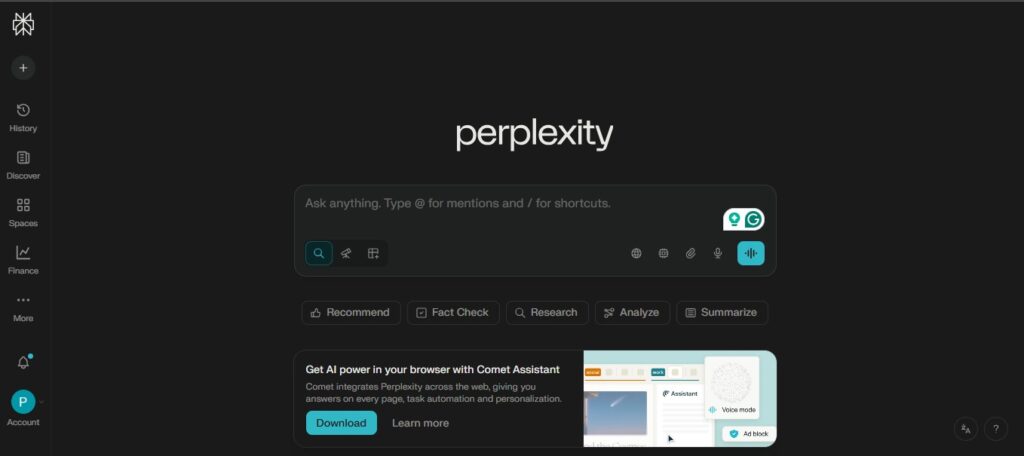
Perplexity’s interface
Perplexity feels similar to a modern search engine. It is clean, fast, and optimized for scanning information. The answers are presented clearly with visible sources, which builds trust and saves time. It is built for users who want to find information quickly and reliably.
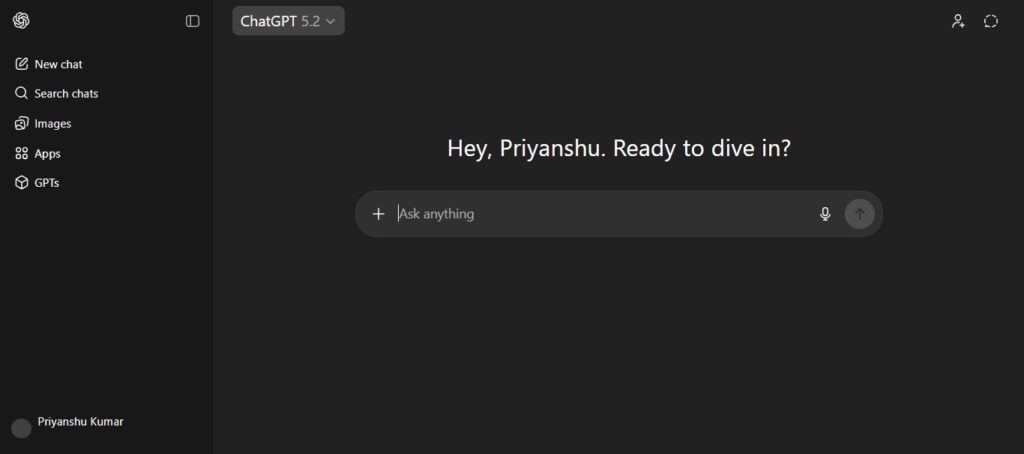
ChatGPT’s Interface: The Blank Canvas for Conversation
ChatGPT interface is very simple. On the left, you have a history of your past conversations. The main part of the screen is the ongoing chat, with your prompt and its response. It is designed to make you feel comfortable having a long and creative dialogue. It lacks default citations, but it provides unmatched flexibility for creative and strategic tasks.
Perplexity vs. ChatGPT: Features Comparison
| Feature | Perplexity | ChatGPT |
| Main Goal | Finding facts and news. It works like a search engine to give you answers from the web. | Creating and chatting. It works like a human-style assistant for writing and talking. |
| Web Search | Always active. It searches the live internet for every question you ask. | Optional. It uses a search tool only when needed or if you turn it on. |
| Sources & Links | Very clear. It lists links and citations for every fact so you can check them. | Less focus. It can provide links, but it usually doesn’t show them as clearly. |
| Creative Writing | Basic. It is better at summaries and short, factual reports. | Excellent. It is great at writing stories, emails, poems, and long essays. |
| Coding | Helpful for tips. Good for explaining code or finding quick examples. | Advanced. It can write, run, and test complex code in many languages. |
| Conversation | Direct. It gives quick, straightforward answers to your questions. | Natural. It feels more like talking to a person and remembers past parts of the chat. |
| AI Models | Many choices. Paid users can switch between different AI models (like Claude or GPT). | OpenAI only. It uses OpenAI’s own models (like GPT-4o or GPT-5). |
| Best Used For | Research, fact-checking, and reading the latest news. | Brainstorming, creative writing, and solving complex problems. |
When comparing features, Perplexity clearly leads in real-time information access and source transparency. ChatGPT stands out in creativity, reasoning, and long-form content generation. Perplexity is more structured and research-driven, while ChatGPT is adaptive and expressive. These differences highlight that the tools are designed to solve different problems rather than replace each other.
Perplexity vs. ChatGPT: Limitations and Risks
Perplexity’s main limitation is creativity. It excels at factual summaries but struggles with emotional writing, storytelling, or brand-driven content. Additionally, its output quality depends heavily on the reliability of available sources. If online information is weak or biased, the results may reflect that.
ChatGPT’s biggest risk is hallucination. It generates confident but incorrect information, especially when asked for specific facts without verification. The free version of CharGPT has limitations related to real-time knowledge access. Like all other AI models, it can reflect biases present in its training data, which affects the answer.
Perplexity vs. ChatGPT: Which One Should You Choose?
Choosing between Perplexity and ChatGPT depends entirely on your task. Perplexity is the better choice for research-heavy work such as market analysis, academic topics, SEO validation, and fact-checking. It prioritizes accuracy and transparency.
You should use ChatGPT if your task involves creativity. If you are a marketer brainstorming ad copy or creating social media posts, a developer writing code, a novelist overcoming writer’s block, or a manager drafting an email, ChatGPT offers more flexibility and depth.
The Powerful Combo: Using Both Together
The most effective approach in 2026 is combining both tools into a single workflow. Start by using Perplexity for research, fact-checking, and understanding a topic from credible sources. Once the information is clear and validated, go to ChatGPT and transform those insights into engaging, structured content.
By doing this, you can reduces error, improve content quality, and save your time.
Key Takeaways
- Perplexity is better for research.
- ChatGPT is better for creative works like writing, creating social media posts, and flexibility.
Final Thoughts
I can’t label one as better than the other, since they work best when used together. One helps you discover and verify information, and the other helps you transform that information into new content. When I need clear answers or facts, I ask questions from Perplexity. When I need to build, write, or create something new, I turn to ChatGPT.
FAQs
Q1. Is Perplexity better than ChatGPT for SEO research?
Yes, for keyword research, topic validation, and fact-checking, Perplexity is more reliable.
Q2. Which tool is better for beginners?
ChatGPT is easier for beginners because it feels more conversational and forgiving.
Q3. Do professionals use both tools?
Yes. Most advanced users combine Perplexity for research and ChatGPT for execution.
Related Blogs: