A few years ago, when I first started using AI in marketing, I thought it would just help with small tasks like fixing grammar, generating a few content ideas, or building basic reports. I didn’t expect it to evolve into something that could analyse customer behaviour, predict purchase decisions, optimise ad spend, and create content faster than most teams.

Today, AI isn’t a future tool. It’s already woven into the daily workflow of marketers, business owners, and agencies. In fact, AI in digital marketing plays a crucial role in content creation, advertising, SEO, analytics, and customer engagement, making marketing strategies more data-driven and effective.
But here’s the truth most people don’t talk about, AI won’t replace good marketers, it will replace marketers who don’t use AI.
In this blog post, I will break down everything about AI in marketing, what it is, how it works, what benefits it brings, its challenges, and how you can use it to grow your business.
What Is AI in Marketing?
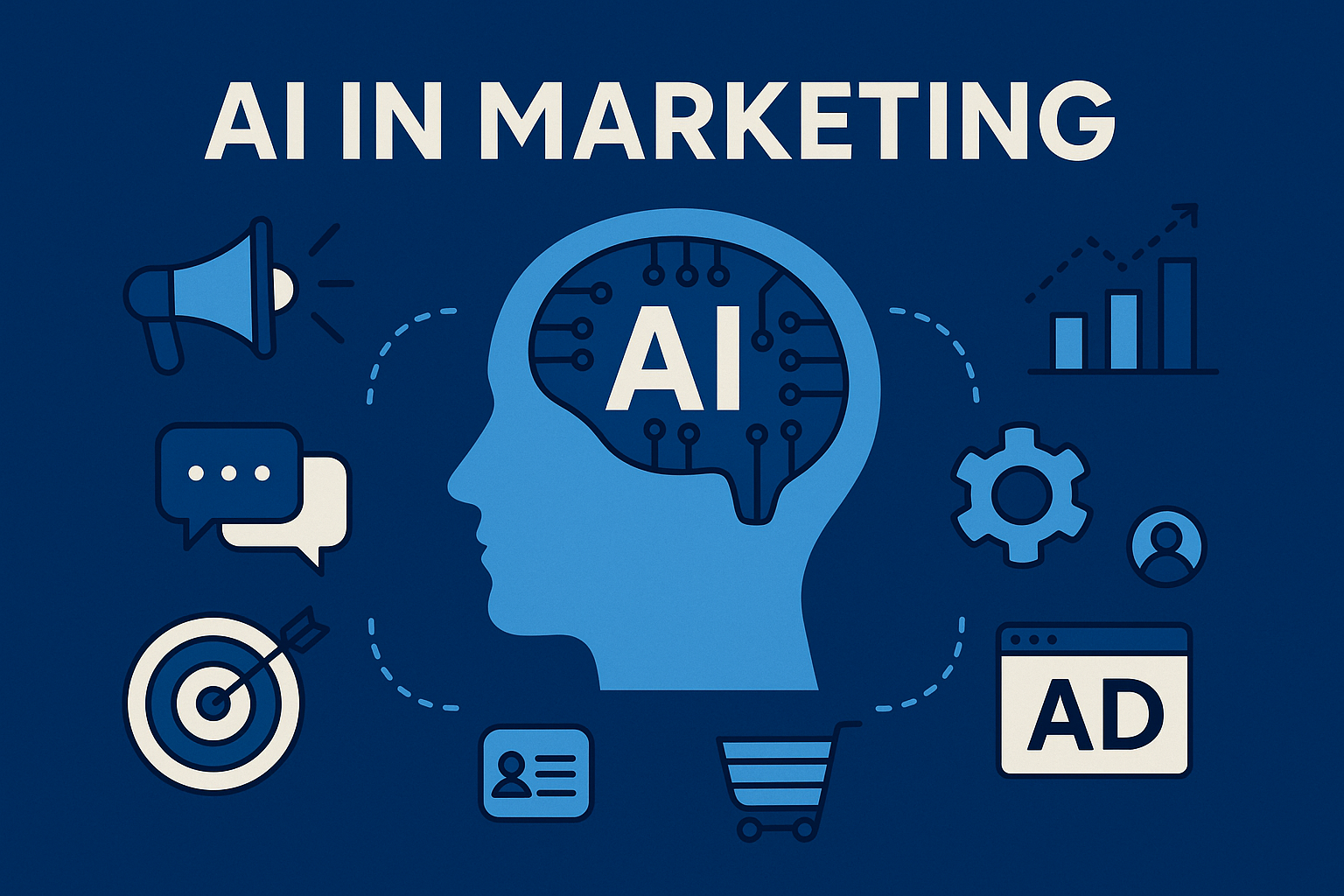
AI in marketing refers to the use of artificial intelligence technologies to understand customers, automate marketing tasks, predict behaviour, and deliver personalised experiences.
This includes things like:
- Content generation
- Email automation
- Ad optimisation
- Customer segmentation
- Predictive analytics
- Personalised product recommendations
- Chatbots
- Social media scheduling
- Data analysis
Instead of relying only on human intuition, marketers now use a combination of data and AI to make smarter decisions with higher accuracy. In practice, AI in digital marketing helps businesses reach the right audience, deliver personalised messages, and optimise campaigns using data rather than guesswork.
Benefits of Using AI in Marketing
AI brings real, measurable benefits. These challenges become more visible in AI in digital marketing, where decisions directly influence reach, engagement, and conversions.
1. AI Helps You Attract and Retain Customers
AI analyses massive amounts of customer behaviour data, what people buy, when they buy, what they click, what they ignore, and then predicts how to attract them better.
It helps you:
- Understand customer segments
- Identify high-value customers
- Retarget users more accurately
- Send personalised offers
- Reduce customer churn
Retention becomes easier because AI tells you what users need before they even say it.
2. AI Uses Data Analytics to Uncover Trends
Humans can analyse thousands of rows of data, but AI can analyse millions.
AI can detect:
- Seasonality patterns
- Purchase trends
- Emerging behaviours
- Product preferences
- At-risk customers
- Market shifts
This gives marketers insights that were impossible to gather manually.
3. AI Understands Business Needs Better With Time
AI systems learn continuously.
The more data, like customer behaviour, campaign performance, product feedback you feed them, the smarter they become.
Over time, AI improves:
- Recommendations
- Predictions
- Targeting accuracy
- Campaign strategy
This reduces guesswork and increases efficiency.
4. AI Improves Business Efficiency
AI automates repetitive tasks like:
- Email scheduling
- Reporting
- Keyword research
- Social media posting
- Lead qualification
- A/B testing
- CRM updates
Your marketing team gets more time for strategy, creativity, and innovation, the work humans are best at.
5. AI Adapts to Different Customer Demographics
AI doesn’t generalise. It tailors messages for specific audiences:
- Age
- Gender
- Past purchases
- Online behaviour
- Geographical location
- Engagement history
Each audience receives the content they are most likely to respond to, increasing conversions.
6. AI Helps You Create Compelling Content
AI tools can:
- Write blogs
- Suggest headlines
- Create product descriptions
- Generate social media posts
- Design visuals
- Write email sequences
Marketers still refine the final output, but AI speeds up the entire process.
7. AI Improves ROI
AI reduces wasted spending by:
- Targeting the right audiences
- Optimising ad budgets
- Predicting which campaigns work
- Reducing time spent on manual tasks
- Increasing conversion rates
How can you use AI in Marketing?
AI is already active in almost every marketing function. Many of these applications are widely used in AI for digital marketing, particularly in content, ads, and customer engagement. Here are the most powerful examples:
1. Content Marketing
AI helps marketers generate ideas, write drafts, optimise SEO, and repurpose content across platforms. It reduces writing time and ensures consistency in tone and structure.
Tools you can use: ChatGPT, Jasper, Notion AI, Surfer SEO, Writesonic.
2. Customer Service Assistants
AI chatbots can answer customer questions instantly, handle FAQs, process basic support requests, and assist with order-related queries. This reduces wait time and frees human agents for complex issues.
They provide 24/7 instant support.
Tools you can use: Intercom AI, Zendesk AI, Freshchat, Drift.
3. Personalisation
AI studies customer behaviour and delivers personalised product suggestions, emails, landing pages, and offers. This makes customers feel understood and boosts conversions.
Tools you can use: HubSpot AI, Klaviyo AI, Dynamic Yield, Mailchimp AI.
4. Predictive Analytics
AI analyses past customer behaviour to predict future actions, such as who will buy, when they’ll buy, and what they’re likely to prefer. This helps brands plan smarter campaigns.
Tools you can use: Google Analytics + AI features, Salesforce Einstein, SAP Predictive Analytics.
5. Social Media Marketing
AI identifies best posting times, trending topics, and high-performing content formats. It schedules posts automatically and analyses engagement to refine strategy.
Tools you can use: Hootsuite AI, Buffer AI, Sprout Social, Later AI.
6. Search Engine Optimization (SEO)
AI supports keyword research, competitor analysis, on-page optimisation, and SERP prediction. It speeds up SEO tasks that used to take hours.
Tools you can use: SEMrush, Ahrefs (AI Insights), Surfer SEO, NeuronWriter.
7. Ad Campaigns
AI optimises ad targeting, bidding, placements, and creative testing to reduce budget waste. It constantly learns and adjusts campaigns for better performance.
Tools you can use: Google Ads AI, Meta Advantage+, Adroll, Taboola AI.
8. E-commerce
- AI recommends products, predicts inventory needs, personalises storefronts, and recovers abandoned carts. This directly increases sales and customer loyalty.
Tools you can use: Shopify Magic, WooCommerce AI plugins, Bloomreach, Algolia.
9. Workflow Automation
AI connects marketing tools, automates repetitive tasks, and reduces operational workload. This improves team efficiency and keeps systems running smoothly.
Tools you can use: Zapier AI, Make.com, n8n, HubSpot Automation, Notion AI Workflows.
These tools are widely used in AI-driven digital marketing strategies to improve visibility and conversions.
Challenges of AI in Marketing
Even though AI brings speed, accuracy, and automation to marketing, it also comes with its own set of limitations. These challenges become even more important when AI in digital marketing is involved, and where decisions directly impact brand visibility, customer trust, and revenue. These challenges can affect data quality, creativity, ethical decisions, and how effectively teams use AI tools in real-world campaigns.
1. Ethics
AI requires access to customer data, which raises concerns about how that data is collected, stored, and used. If marketers misuse or mishandle this data, it can break customer trust and even lead to legal issues. Ethical AI usage requires transparency, consent, and responsible data practices.
2. Expertise
AI tools may be easy to operate, but using them strategically requires skill and training. Many marketing teams lack knowledge in AI analytics, automation, and prompt engineering, which limits the tool’s full potential. Without proper expertise, businesses end up underusing or misusing AI.
3. Data Quality
AI systems can only learn from the information they receive, so poor or incomplete data results in inaccurate predictions and wrong marketing decisions. If your CRM, website analytics, or customer data is messy, AI will produce weak results. Clean, organised, and updated data is essential for effective AI-driven marketing.
4. Creativity
AI can generate content quickly, but it still struggles with originality, emotional depth, and brand storytelling. Marketing requires human imagination—something AI cannot replicate. If a brand depends too much on AI, its content may become generic and lose its unique voice.
You can also go through this quick reel for Tools you can use everyday to make your professional Life Easy!
Best Practices for Using AI in Marketing
Here’s how to use AI effectively, without overwhelming your team:
1. Set Clear Goals Before You Start
Ask yourself:
- What problem do I want AI to solve?
- What output do I expect?
- How will I measure success?
AI works best with clarity.
2. Ensure Data Accuracy and Completeness
Correct data means accurate AI insights.
Incomplete or incorrect data leads to bad marketing decisions.
3. Use AI to Unify and Analyse Your Data
AI can bring together data from:
- CRM
- Ads
- Social media
- Website analytics
- Email platform
This gives a 360° view of the customer.
4. Don’t Try to Implement Everything at Once
Start small:
- Automate emails
- Use AI for analytics
- Use AI for content creation
Expand step by step.
5. Train Yourself and Your Team in Prompt Engineering
Better prompt gives better output.
Your team must learn:
- How to write prompts
- How to refine AI content
- How to validate AI suggestions
This simple skill can double productivity.
6. Automate Repetitive Marketing Tasks
Use AI for:
- Reporting
- Scheduling posts
- Audience segmentation
- Email sequences
This frees your team for creative and strategic work.
Economic Implications: How AI Is Changing Marketing Jobs?
AI is changing the marketing job landscape, but not in the “robots will replace us” way.
Jobs that may reduce:
- Basic content writers
- Manual data analysts
- Social media schedulers
- Entry-level PPC managers
Jobs that will grow:
- AI trainers
- AI content editors
- Data-driven strategists
- Performance marketers
- Conversion rate optimization experts
- Marketing automation specialists
AI replaces tasks, not talent. Marketers who use AI will become faster, smarter, and more valuable.
Key Takeaways
- AI helps marketers analyse data, personalise experiences, and automate tasks.
- It improves efficiency, customer satisfaction, and ROI.
- AI does not eliminate human creativity, strategy, or judgement.
- Good data, clear goals, and a skilled team are essential for success.
- The future belongs to marketers who combine human insight with AI power.
Final Thoughts
AI is not here to replace marketers. It’s here to remove the repetitive, time-consuming, manual workload that slows them down.
The future of marketing is human creativity + AI intelligence working together.
AI gives you faster insights, better targeting, deeper personalisation, and smarter decisions, but only humans can bring strategy, storytelling, ethical judgement, emotional understanding, and brand identity.
If you’re a business owner or an employee, it is the perfect time to start using AI, not to replace your team, but to empower them.
Those who adapt will grow faster, those who resist will fall behind.
FAQs
1. Is AI difficult for marketers to use?
No. Most modern tools are beginner-friendly and require no coding.
2. Is AI in digital marketing useful for small businesses?
Yes, AI in digital marketing helps small businesses save time, improve targeting, and increase ROI with limited budgets.
3. Can AI replace creative marketing?
AI assists creativity but cannot replace human storytelling or emotional understanding.
4. Is AI expensive for small businesses?
Many AI tools offer free or low-cost plans, making them accessible.
5. Does AI guarantee better marketing results?
No, results depend on good data and human supervision.
6. What AI tools are best for marketing?
The best marketing AI tools are ChatGPT, Jasper, Canva AI, HubSpot AI, SEMrush, Midjourney, Zapier AI.
7. Do marketers need to learn prompt engineering?
Yes. Better prompts lead to better AI output and faster work.
Suggested Blogs: