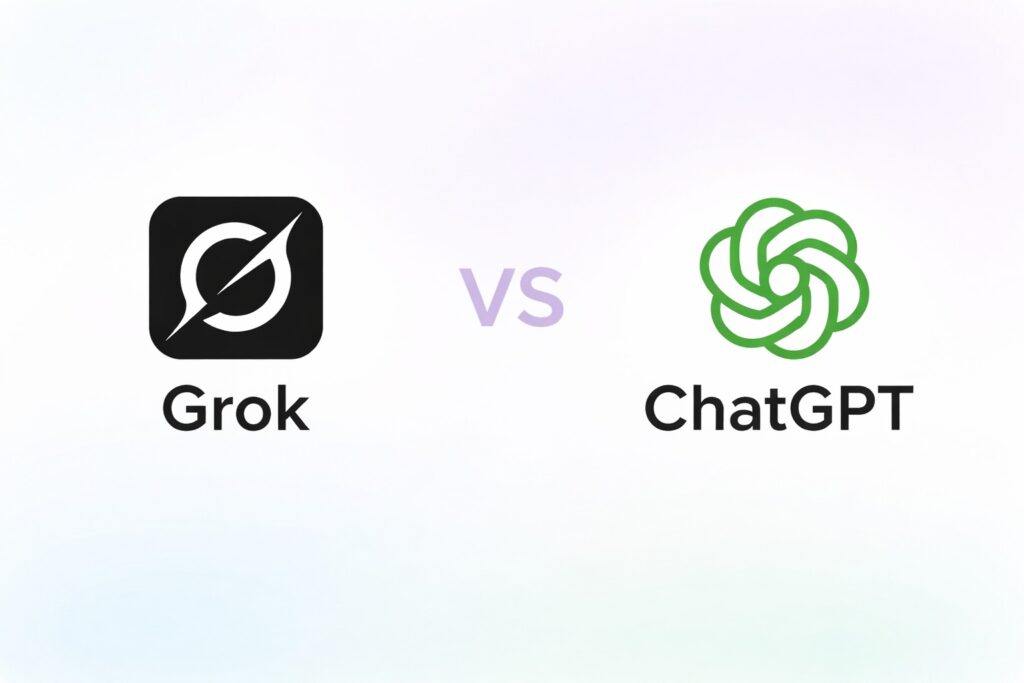
In today’s AI market, two big players are quickly changing the industry. On one side is OpenAI’s ChatGPT, which people around the world use for productivity, creativity, and daily tasks. On the other side is Elon Musk’s Grok AI, known for its bold and witty style and its integration with X (formerly Twitter). Both are powerful tools with their own strengths, but choosing between Grok AI and ChatGPT can feel confusing.
When comparing Grok and ChatGPT, you are looking at two major AI systems with many features and abilities. That is why it is important to clearly understand what each tool offers before deciding which one is better for your needs.
In 2025, both models received major upgrades. ChatGPT improved its multimodal abilities, allowing better interaction through voice, images, and video. At the same time, Grok 4 introduced stronger real-time reasoning and expanded tool access beyond simple text responses. These updates make the comparison between the two tools more important than ever.
Choosing between them is not about which AI is better. It is about which AI fits your real needs. This guide explains Grok vs ChatGPT in detail, and which one is best for you.
What is ChatGPT?
ChatGPT is a conversational AI assistant designed to understand language, answer questions, generate content, assist with coding, and support learning across many topics. It works through natural dialogue, meaning users can ask follow-up questions, refine instructions, and explore ideas step-by-step.
Its biggest strength is versatility. Students use it for explanations, marketers use it for content, developers use it for debugging, and professionals use it for planning and research. Instead of focusing on one platform, ChatGPT works as a general-purpose thinking and creation assistant.
What is Grok AI?
Grok AI is an AI assistant created with a different personality and purpose. It connects closely with the X (formerly Twitter) ecosystem and focuses strongly on real-time information, social trends, and conversational engagement.
Unlike traditional neutral assistants, Grok often uses a more informal, witty, or sarcastic tone. This design choice aims to make interactions feel lively and current rather than purely professional.
Grok’s core strength lies in awareness of live conversations and cultural context, especially from social media environments.
Origins and Development Background: Grok vs ChatGPT
ChatGPT emerged from a research-driven environment focused on safe, structured, and widely usable AI systems. Its development emphasizes reliability, reasoning ability, and adaptability across industries such as education, business, and software development.
Grok, on the other hand, comes from a technology and social-platform ecosystem that values speed, real-time awareness, and expressive interaction. Its design reflects the fast-moving nature of online conversations rather than traditional enterprise software expectations.
Model Architecture: ChatGPT vs Grok
Both ChatGPT and Grok rely on large language model (LLM) technology built using deep learning and transformer-based architectures. These models learn patterns from massive datasets and generate responses by predicting meaningful language sequences.
However, their optimization goals differ.
ChatGPT prioritizes balanced reasoning, clarity, and safety. It aims to deliver consistent answers across education, coding, writing, and research tasks.
Grok prioritizes speed, real-time awareness, and conversational personality. It focuses more on contextual relevance within current discussions, especially those emerging from social platforms.
So while the underlying technology category is similar, the behavioral tuning creates very different user experiences.
Features: Grok vs ChatGPT
| Feature | xAI Grok | OpenAI ChatGPT |
| Response Style | Witty: Known for Spicy Mode, offering sarcastic, unfiltered, and edgy responses. | Polished & Professional: Balanced, helpful, and safety-conscious. It focuses on clarity, instruction-following, and neutral tone. |
| Text Format | Flexible but Raw: Excellent for short-form social copy, viral threads. | Highly Structured: Superior for long-form essays, formal reports, and complex documentation. |
| Data Access | Real-Time Firehose: Direct, live access to X (formerly Twitter) data and trends via DeepSearch. No knowledge cutoff. | Deep Research: Browses the web for verified sources and citations. Balanced depth with a structured, cited approach. |
| Multimodal Capabilities | Native Multimodality: Understands text, images, and video streams natively. Includes high-fidelity Grok Imagine video generation. | Full Omni-Suite: Advanced image (DALL-E 4), audio (Advanced Voice Mode), and video (Sora) integration with high safety guardrails. |
| Key Strengths | Real-Time Awareness: Best at tracking sentiment, breaking news, and cultural trends as they happen. Massive 2M context window. | Productivity Ecosystem: Powerful agentic capabilities, Custom GPTs, and deep integration with Google Workspace/Microsoft 365. |
| Use Case | The Internet Pulse: Social media managers, journalists, crypto/market analysts, and users seeking unfiltered truth. | The Office Powerhouse: Students, developers, corporate teams, and researchers needing reliable, polished, and safe output. |
Limitations and Risks: Grok vs ChatGPT
No AI system is perfect. Understanding weaknesses helps users avoid blind trust and misuse.
Limitations of ChatGPT
Lack of Real-Time Data: ChatGPT may not always reflect the latest live events unless connected to updated information sources. This can limit usefulness for breaking news or rapidly changing topics.
Too Polished and Safe: Its responses often feel very careful and structured. While this improves reliability, some users find the tone less lively or spontaneous.
Bias and Hallucination: Like all AI models, ChatGPT can produce incorrect or biased information if prompts lack clarity or context.
Image Generation Limitations: Although multimodal features exist, creative image control or precision may not match specialized design tools.
Limitations of Grok AI
Platform Dependent: Grok’s strongest advantages appear inside its native ecosystem. Outside that environment, its differentiation becomes smaller.
Informal and Sarcastic Tone: Its expressive tone can feel engaging, but in professional or academic contexts, it may appear less appropriate.
Early Stage Maturity: Compared to long-established AI assistants, Grok is still developing depth and stability across many domains.
Still Maturing: Features, reliability, and ecosystem integrations continue evolving, which means inconsistency may appear during growth phases.
Common Risks in ChatGPT and Grok AI
Both tools share broader AI-related concerns:
- Data Privacy: Sensitive information should never be shared carelessly.
- Misinformation: AI output must always be verified before real-world use.
- Overdependence: Relying completely on AI can weaken human judgment.
Understanding strengths and risks ensures safer, smarter usage.
Key Capabilities: ChatGPT vs Grok
AI assistants support education, creativity, coding, and research. Both Grok and ChatGPT perform well in several shared areas.
Common capabilities
Conversational Tasks: Both tools can hold natural conversations, answer follow-ups, and explain complex topics in simple language.
Content Generation: They can generate articles, summaries, scripts, and ideas quickly, saving significant writing time.
Code Assistance: Both help with coding logic, debugging hints, and explanations for programming concepts.
Creative Tasks: Story ideas, brainstorming, and imaginative writing work well in both systems.
Distinct capabilities
Grok AI
Real-time Data Access: Grok’s strongest advantage is awareness of current conversations and trends, which helps in news-driven or social analysis tasks.
Social Media Understanding: Because of its ecosystem connection, Grok interprets online culture, humor, and public sentiment more naturally.
Domain-Specific Niche: Its design favors fast commentary, trend analysis, and conversational engagement rather than deep academic structure.
ChatGPT
Versatility: ChatGPT adapts across education, business, coding, writing, and research, making it suitable for diverse users.
Critical Thinking or Nuanced Analysis: It performs strongly in step-by-step reasoning, comparisons, and structured explanations.
Long-form Content Creation: Blogs, reports, and detailed guides remain one of its biggest strengths due to coherent structure and clarity.
Multimodal Capabilities: ChatGPT increasingly supports images, documents, and broader interaction modes, expanding practical usefulness.
Overall, Grok excels in real-time awareness and personality, while ChatGPT stands out for depth, reasoning, and versatility. Your ideal choice depends on your daily tasks.
Future Directions: ChatGPT vs Grok
The future of AI assistants will likely combine real-time awareness, deep reasoning, multimodal interaction, and autonomous task execution.
ChatGPT may continue expanding toward broader intelligence, professional workflows, and multimodal ecosystems. Grok may evolve toward stronger real-time intelligence, cultural awareness, and tighter platform integration.
Over time, the gap between them could shrink as both adopt each other’s strengths. Competition in AI rarely ends with one winner. It usually creates better tools for everyone.
Key Takeaways
- ChatGPT is a versatile, structured, and reliable AI assistant.
- Grok focuses on real-time context, social awareness, and expressive tone.
- Both share strong abilities in conversation, content, coding, and creativity.
- Each has limitations related to accuracy, tone, maturity, and privacy risks.
- The best choice depends on your workflow, not brand popularity.
Final Thoughts
The Grok vs ChatGPT debate is not about superiority. It is about purpose. If you want deep explanations, structured writing, and broad usefulness, ChatGPT fits naturally. If you want real-time awareness, social context, and energetic interaction, Grok feels more aligned. Don’t treat AI tools like rivals. Use the right tool at the right moment.
FAQs
1. Which is better: Grok or ChatGPT?
Neither is universally better. ChatGPT suits structured reasoning and content creation, while Grok suits real-time and social-context tasks.
2. Can Grok and ChatGPT be used together?
Yes. You can combine multiple AI tools to benefit from different strengths.
3. Is Grok more accurate than ChatGPT?
Accuracy depends on the task. Real-time topics may favor Grok, while analytical or long-form tasks may favor ChatGPT.
4. Which AI is better for students?
ChatGPT supports learning, explanations, and structured study more effectively.
5. Will Grok and ChatGPT replace human thinking?
No. AI assists thinking, but human judgment, creativity, and responsibility remain essential.
Related Blogs: