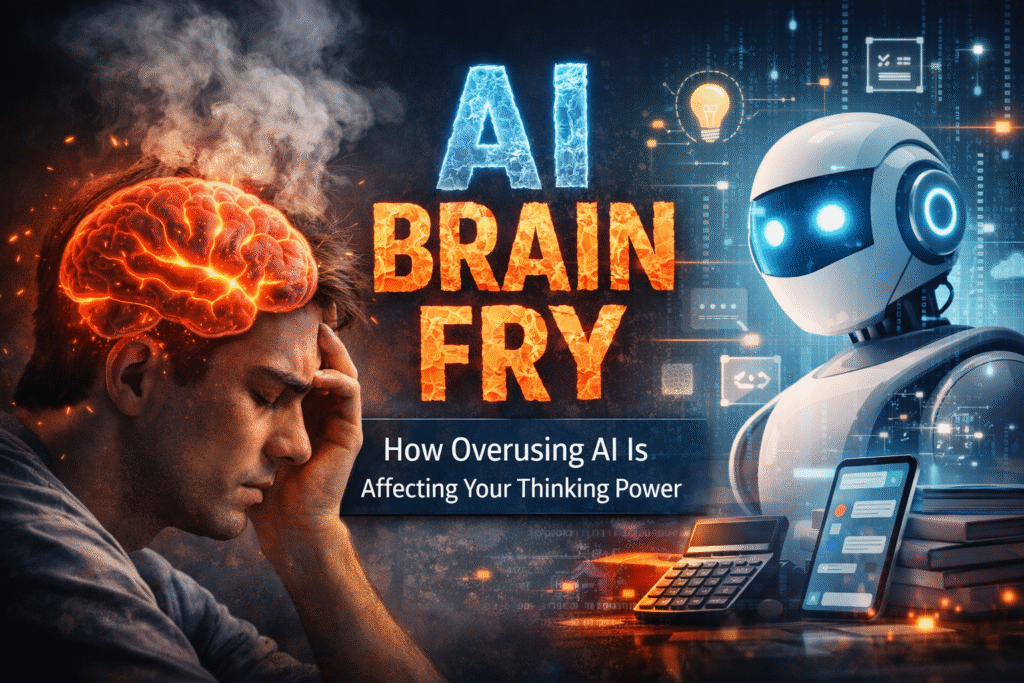
Have you noticed that instead of thinking through a problem, you immediately ask AI for the answer?
From writing emails to solving complex questions, tools like ChatGPT, Claude, and Google Gemini are becoming our default way of thinking.
But recent research suggests this convenience may come at a cost.
A study discussed by Harvard Business Review found that excessive use of AI can lead to a new cognitive issue called “AI Brain Fry.” This refers to mental fatigue caused not just by using AI, but by constantly managing, reviewing, and interacting with multiple AI systems.
In a survey of nearly 1,500 full-time workers, about 14% reported experiencing symptoms such as mental fog, slower thinking, and difficulty concentrating. Interestingly, the fatigue did not come from doing more work, but from supervising AI outputs and switching between tools.
This growing phenomenon is now being called “AI Brain Fry”, and it is changing how we think, work, and learn in the AI era.
What is AI Brain Fry?
AI Brain Fry refers to the decline in independent thinking and increased mental fatigue caused by excessive reliance on AI tools.
In simple terms:
- Your brain does less deep thinking
- You rely on AI for answers
- You feel mentally drained despite “working smarter”
Unlike earlier technologies, AI does not just assist, it replaces parts of thinking, which makes overdependence more impactful.
The Science Behind AI Brain Fry
Cognitive Offloading
AI Brain Fry is closely linked to Cognitive Offloading, the tendency to rely on external tools instead of using your brain.
Examples include:
- Using AI instead of analyzing
- Asking AI instead of remembering
- Delegating thinking to machines
Over time, this reduces mental effort and engagement.
The Google Effect
Research from Columbia University showed that people are less likely to remember information if they know it is easily accessible online.
With AI, this effect becomes stronger:
- You don’t just search less
- You think less before getting answers
AI-Specific Cognitive Load (New Insight)
According to findings discussed by Harvard Business Review:
- Managing multiple AI tools increases cognitive load
- Constantly reviewing AI-generated outputs requires mental effort
- Switching between tools disrupts focus
This creates a paradox:
AI saves time, but also increases mental fatigue when overused.
Signs You Might Have AI Brain Fry
You may be experiencing AI Brain Fry if:
- You ask AI before thinking yourself
- You feel mentally tired even after simple tasks
- You struggle to focus without AI assistance
- You forget information quickly
- You avoid deep thinking tasks
These signs point to reduced cognitive engagement, not reduced intelligence.
Real-Life Examples
Students
Students using AI for assignments often:
- Skip problem-solving
- Lose conceptual clarity
Professionals
Workers using AI tools heavily report:
- Decision fatigue
- Increased mental exhaustion from reviewing outputs
Creators
Content creators relying on AI may:
- Lose originality
- Produce generic content
Is AI Really the Problem?
AI is not the problem. Misuse is.
AI can:
- Improve productivity
- Enhance learning
- Save time
But research shows that constant supervision of AI outputs and over-reliance can create mental overload.
Key idea:
AI does not reduce intelligence, it reduces the need to use it.
How to Use AI Without Damaging Your Brain
1. Think First, Then Use AI
Give your brain time to process before asking AI.
2. Limit Tool Switching
Using too many AI tools increases mental fatigue. Stick to one or two core tools.
3. Use AI for Enhancement, Not Replacement
Ask AI to:
- Improve your ideas
- Review your work
- Offer suggestions
Avoid asking it to do everything from scratch.
4. Build “Deep Thinking Time”
Spend at least 30–60 minutes daily:
- Writing without AI
- Solving problems manually
- Reflecting
5. Actively Engage With AI Output
Instead of copying:
- Question the response
- Edit it
- Understand it
AI Brain Fry vs AI Empowerment
| Aspect | AI Brain Fry | AI Empowerment |
|---|---|---|
| Usage | Passive | Active |
| Thinking | Reduced | Enhanced |
| Learning | Surface-level | Deep understanding |
| Mental State | Fatigue | Clarity |
| Dependency | High | Controlled |
Future Impact of AI on Thinking
If current trends continue:
- Cognitive fatigue may increase
- Attention spans may shrink
- Creativity may decline
However, if used wisely:
- Humans can think faster and better
- AI can amplify intelligence instead of replacing it
The future depends on how we adapt.
Conclusion
AI is one of the most powerful tools ever created. But like any tool, its impact depends on how we use it.
AI Brain Fry is not about losing intelligence. It is about losing the habit of thinking.
If you stay aware and intentional, AI can enhance your brain — not replace it.
FAQs
What is AI Brain Fry?
AI Brain Fry is mental fatigue and reduced thinking ability caused by overusing AI tools.
Does AI cause mental fatigue?
Yes, research suggests that managing multiple AI tools and reviewing outputs can increase cognitive load and fatigue.
How can I avoid AI Brain Fry?
Use AI in moderation, think independently, and avoid relying on it for every task.
Also Read:
- Can an AI robot replace Teachers, Coders & Factory Workers in 2026?
- Best AI Tools For Resume Building to Improve Your Career Growth